Eco-Communities
And through the bamboo, Anthony clearly sees a forest of columns, of a bluish-grey hue. They are tree trunks springing from a single trunk. From each of its branches descend other branches that sink into the ground; and the whole of these horizontal and perpendicular lines, multiplied without end, would resemble a monstrous framework, were it not for the small figs appearing here and there, with dark foliage like that of the sycamore.
The Temptation of Saint Anthony by Gustave Flaubert (1874)


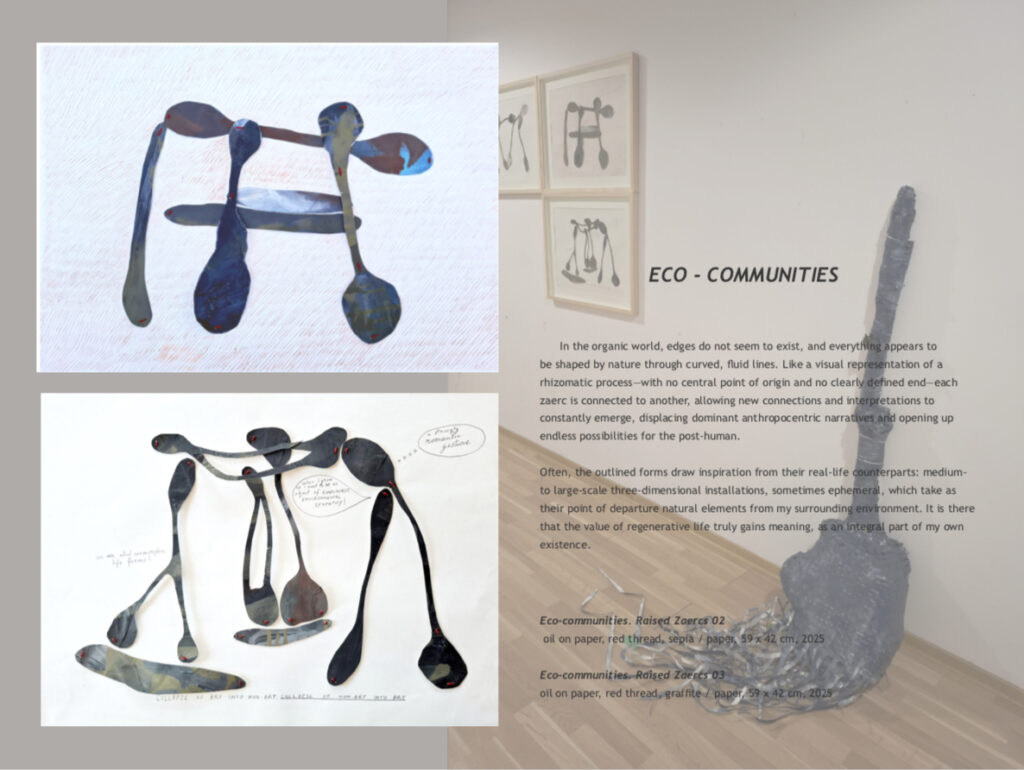
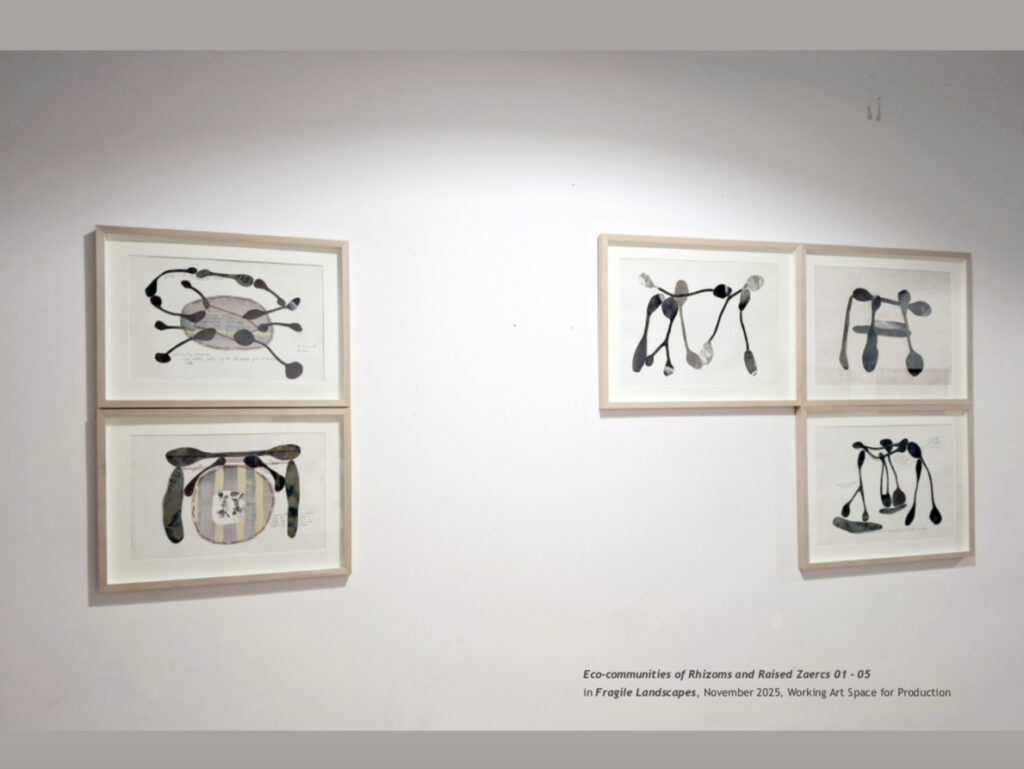
In the organic world, edges do not seem to exist, and everything appears to be shaped by nature through curved, fluid lines. Like a visual representation of a rhizomatic process—with no central point of origin and no clearly defined end—each zaerc is connected to another, allowing new connections and interpretations to constantly emerge, displacing dominant anthropocentric narratives and opening up endless possibilities for the post-human. Often, the outlined forms draw inspiration from their real-life counterparts: medium- to large-scale three-dimensional installations, sometimes ephemeral, which take as their point of departure natural elements from my surrounding environment. It is there that the value of regenerative life truly gains meaning, as an integral part of my own existence.
Older series that influenced recent Eco-Communities
In 2014 I had access to an amazing lithographic studio and practice, inside Atelier Hurstel, where some of my lithographies were born, although most of them abandoned in France.